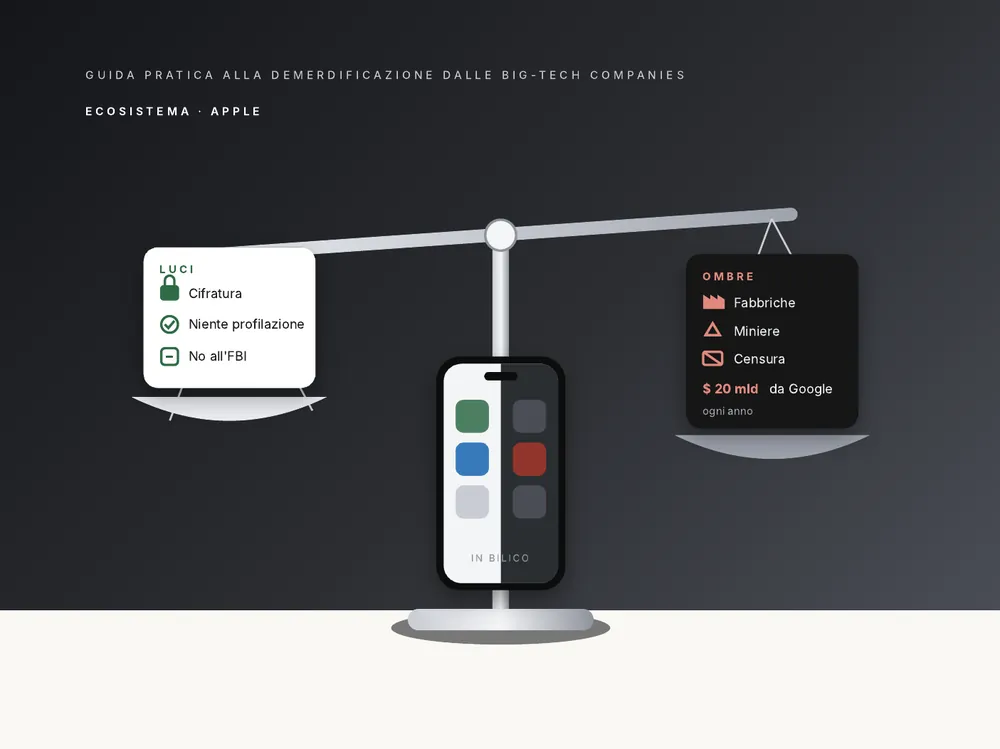
This guide is different from the others: it does not explain a move to a service we recommend, but sets out Apple’s ethical and less ethical sides, so that everyone can decide knowingly. The key is the business model: Google and Meta earn by selling targeted ads, Apple mostly by selling devices. For Apple, privacy is a selling point: it protects it as long as that suits it. It is a good ally, but not a friend.
The bright side
- Less data, and encrypted: many features work on the phone itself; passwords, health data and 13 other categories are end-to-end encrypted. With Advanced Data Protection, free, encryption extends to backups, photos, notes and iCloud Drive.
- App Tracking Transparency: since 2021 every app must ask permission before following you across apps and websites.
- When it said no: in 2016 to the FBI, which wanted an iOS to unlock an iPhone; in 2025 to the British government, withdrawing Advanced Data Protection from the UK rather than building a back door.
- Longevity and repairs: usually 6–7 years of updates, spare parts and manuals. Apple states that 76% of the cobalt in its devices was recycled in 2024.
- The Albanese report names Google, Amazon, Microsoft and IBM; Apple does not appear.
The shadows
- Factories in China: in September 2025 China Labor Watch documented at Foxconn Zhengzhou, during iPhone 17 production, more than half the workforce on agency contracts (five times the legal limit), excessive overtime and intimidation.
- Forced labour and mines: in 2020 ASPI named Apple among the companies benefiting from forced transfers of Uyghur workers; in 2024 the Congo filed complaints against its French and Belgian subsidiaries over “blood minerals”. Apple rejects the accusations.
- Censorship: Chinese users’ iCloud data is hosted by a state company; in 2024 Apple removed WhatsApp, Signal and Telegram from the Chinese App Store, and in October 2025 in the US it removed ICEBlock at the Attorney General’s request.
- The unexpected partner: Google pays Apple about 20 billion dollars a year to be Safari’s default search engine, and since January 2026 the new Siri is based on Google’s Gemini models.
- Money and power: 13 billion euros of illegal tax advantages from Ireland (EU Court of Justice, 2024), a 500-million EU fine over the App Store (2025), fines over App Tracking Transparency (150 million in France, 98.6 in Italy). In 2025 Tim Cook personally gave one million dollars to Trump’s inauguration committee.
- Israel: it is not in the report, but has about 2,000 people in its Israeli research centres and in January 2026 bought the start-up Q.ai.
If you choose Apple, choose it well
The most ethical phone is the one you already have. If you must change, consider a refurbished or second-hand iPhone and keep it for a long time. Then, on day one:
- Change the search engine: Settings → Apps → Safari → Search Engine (for example DuckDuckGo), or install Brave. That way your searches stop funding Google.
- Turn off Apple’s ads: Privacy & Security → Apple Advertising → turn off personalised ads.
- Block tracking: Privacy & Security → Tracking → turn off “Allow Apps to Request to Track”.
- Don’t send analytics: Privacy & Security → Analytics & Improvements, turn everything off, including “Improve Siri & Dictation”.
- Siri and AI, with judgement: turn off the ChatGPT extension; the new Siri uses Google models, and you can switch it off.
- Protect your mail: Apps → Mail → Privacy Protection → “Protect Mail Activity”.
- Turn on Advanced Data Protection (Settings → your name → iCloud), but only after moving your photos from Google, and write the recovery key on your sheet.
For photos, Google Takeout’s dedicated transfer page moves them straight to iCloud Photos; the free 5 GB is usually not enough. For music: Settings → Apps → Music → Transfer music from other music services.
So, is it a reasonable choice?
Yes, for anyone who wants to leave Google’s ecosystem without giving up the convenience of a complete system, on three conditions: set it up well (Advanced Data Protection, a non-Google search engine, no tracking); don’t put all your eggs in one basket (email, passwords, messages and social media stay on independent services); buy less and keep it longer. On privacy, trust is reasonable within clear limits; on corporate ethics, it is not. Choosing Apple is not an ethical choice: at best it is the lesser evil. Those who want more can look at a Fairphone with /e/OS and a computer with Linux.
To be honest: the limits
- iOS code is closed: on privacy you trust what Apple says, only partly verified by outside researchers.
- Apple is an American company: without Advanced Data Protection it holds the keys to backups and photos, and governments can ask it for the data.
- The British case shows that a government can remove a protection overnight.
- Apple’s service prices rose several times in 2026, and full backups work only with iCloud.
Apps often rename their menu items: if you can’t find one exactly as written, look for the closest match.
Checklist
Your ticks are saved only in this browser.
The full guide
The PDF, in Italian, contains every step, the images, the most common questions and the page of sources.